

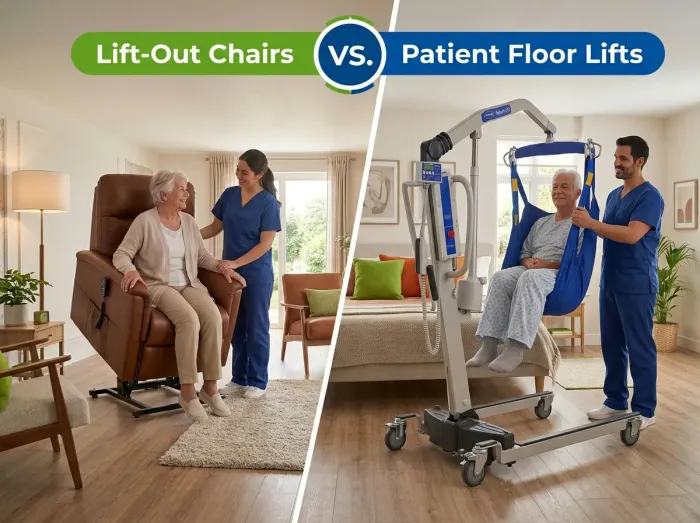
When getting up, sitting down or moving between bed and chair becomes difficult, two pieces of equipment often come up: the lift-out chair and the patient floor lift. Both make daily transfers easier, but they are built for different situations, and choosing the wrong one can mean wasted money and frustration at home.
This guide explains how each option works, who it suits and what to check before you decide, so you can walk into a consultation in Ottawa with the right questions.
A lift-out chair suits someone who can stand with a little help and wants to sit down and get up on their own. A patient floor lift suits someone who cannot stand or bear weight and needs a caregiver to move them with a sling between bed, chair, commode or wheelchair. The right choice depends on the person’s standing ability, who is helping and the space in your home. Core Medical Equipment in Ottawa can help you match the equipment to your situation.
Feature | Lift-Out Chair | Patient Floor Lift |
|---|---|---|
| How it works | Power-assisted seat that helps move from sitting to standing | Wheeled mobile lift with a boom and sling that raises and moves the person |
| Best suited to | People who can stand with some assistance | People who cannot stand or bear weight |
| Who operates it | Often the user, with a hand control | A caregiver |
| Where it works | One spot in the home, such as the living room or bedroom | Any room with enough floor space, since the lift rolls |
| Installation | Delivered and set up; no structural work | No permanent installation |
| Needs in the home | Room for the chair and its recline | Clear floor space, room to manoeuvre and a sling that fits |
| Short-term option | Ask us about options | Patient lifts and slings are available to rent |
| Main benefit | Independence when getting up from a seat | Smoother transfers and less physical strain on caregivers |
A lift-out chair (also called a lift chair or power lift recliner) has a built-in power mechanism that gently tilts and raises the seat to help the user move from sitting to standing. A hand control puts the user in charge, so there’s no need to wait for someone else.
Lift-out chairs are a strong fit when:
Features vary by model. The Pride Muskoka LC-475 lift chair recliner, for example, offers a three-position design, power headrest, power lumbar support, USB charging ports and battery backup. It comes in Small, Medium and Large, and fit matters: a chair that is too big or too small won’t work as well for the person using it.
Keep in mind: a lift-out chair helps with standing from one seat. It does not move a person from bed to chair, or to the commode.
A patient floor lift (often called a mobile lift, portable patient lift or Hoyer-style lift) is a wheeled frame with a boom and a motor or hydraulic pump. A sling is placed under the person, attached to the boom and raised, and the caregiver gently rolls the lift to the new position, such as from bed to wheelchair.
Patient floor lifts are a strong fit when:
Slings are essential, and the right style depends on the transfer and the person using it. Core Medical Equipment carries slings compatible with ceiling and mobile lifts and can guide you on sizing and compatibility.
Keep in mind: floor lifts need space. Check hallway and doorway widths, bedroom and bathroom clearance, flooring and whether the lift can get in close to the bed or chair. A caregiver also needs to be shown how to use the lift and sling properly. We provide guidance on safe use with rentals.
She cannot stand on her own for now, and moving her from bed to wheelchair is the hardest part of the day. A patient floor lift with a well-fitted sling lets him handle transfers more steadily. Because her recovery is expected to last a few months, a rental is worth considering before any purchase. A lift-out chair wouldn’t help here, since she can’t stand through the movement.
He has trouble getting up from the sofa, but he can stand once he’s upright. A lift-out chair gives him the boost he needs and lets him get up on his own. A floor lift would be more equipment than he needs. These are common examples, not recommendations. Every situation is different, which is why a personal assessment matters.
An occupational therapist or your care team can also advise on which type of equipment suits the person’s abilities. Bring their recommendations to your consultation.
Yes. Many households use a lift-out chair for everyday sitting and standing, plus a floor lift when a caregiver-assisted transfer is needed. If your needs may change over time, ask us how the pieces can work together.
Don’t Forget the Rest of the Room
Lifts work best as part of a complete setup. Depending on your home, you may also want to look at:
At Core Medical Equipment, we’ve spent over 20 years helping families, clinics and care providers find equipment that fits. We’ll listen to your situation, talk through your home and recommend the right solution, whether that is a lift-out chair, a patient lift or a combination. Our accessibility equipment range includes lift-out chairs, ceiling lifts, slings, ramps and more, with delivery, setup and ongoing support from our team.
Ready to find the right fit? Contact us or call (613) 842-7474 to book a consultation, or visit our showroom at 595 Montréal Rd, Suite 101, Ottawa.
Yes. Core Medical Equipment lists patient lifts and slings among its rental equipment, with delivery, setup and phone support. Call (613) 842-7474 or contact us to check availability and rental terms.
Size depends on the user’s height, seated posture and comfort. Some models, such as the Pride Muskoka LC-475, come in Small, Medium and Large. Trying the chair in person with guidance from our team is the best way to confirm fit.
Core Medical Equipment, at 595 Montréal Rd in Ottawa, carries lift-out chairs and accessibility equipment and offers patient lifts and slings for rental. Book a consultation to discuss your needs.