

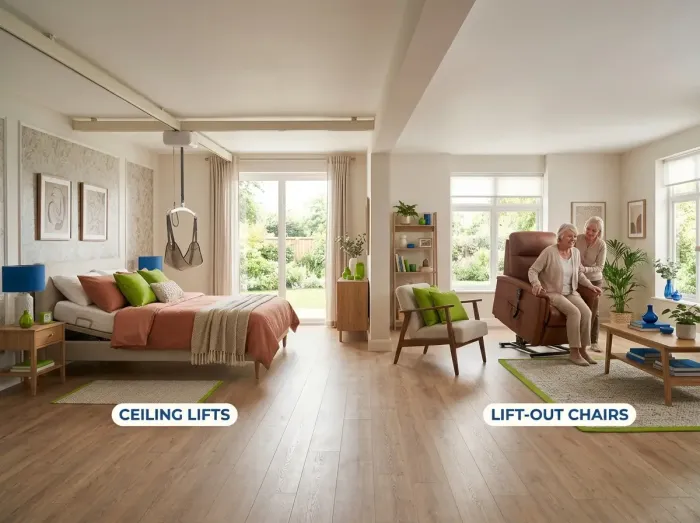
Choosing between a ceiling lift and a lift-out chair is one of the most common decisions Ottawa families face when moving around the home becomes harder. Both products make daily transfers easier. They solve different problems, though, and picking the wrong one can mean money spent on equipment that doesn’t match the person using it.
This guide explains how each option works, who it suits, and what to check before you buy, so you can walk into a consultation with the right questions.
A ceiling lift suits someone who cannot stand or bear weight and needs a caregiver to move them safely between bed, chair and bathroom. A lift-out chair suits someone who can stand with a little help and wants to sit down and get up on their own. The right choice depends on the person’s standing ability, the caregiver’s role and the layout of your home. Core Medical Equipment in Ottawa carries both and can help you match the equipment to your situation.
Feature | Ceiling Lift | Lift-Out Chair |
|---|---|---|
| How it works | Motorized unit on a ceiling track, used with a sling | Power-assisted seat that helps move from sitting to standing |
| Best suited to | People who cannot stand or bear weight | People who can stand with some assistance |
| Who operates it | Usually a caregiver | Often the user, with a hand control |
| Where it works | Bed, chair, bathroom and other rooms covered by the track | One spot in the home: the living room, bedroom or den |
| Floor space | None, since the system sits overhead | Needs room for the chair and its recline |
| Installation | Professional installation of the track | Delivered and set up; no structural work |
| Fit depends on | Home layout, track route and sling selection | Seat size and depth matched to the user |
| Main benefit | Smoother transfers and less physical strain on caregivers | Independence when getting up from a seat |
A ceiling lift (sometimes called an overhead track lift or patient lift) is a motorized system mounted on a track fixed to the ceiling. A sling holds the person, and the motor raises and moves them along the track. Because the track does the carrying, a caregiver isn’t lifting body weight by hand.
Ceiling lifts are a strong fit when:
Slings are part of the system, and the right style depends on the type of transfer and the person using it. Core Medical Equipment carries slings compatible with ceiling and mobile lifts and can guide you on sizing and compatibility.
Keep in mind: a ceiling lift is a fixed installation. The track route is planned around your home, so a home consultation is the right first step.
A lift-out chair (also called a lift chair or power lift recliner) is a chair with a built-in power mechanism that gently tilts and raises the seat to help the user move from sitting to standing. The user controls it with a hand control, so there is no need to wait for someone else.
Lift-out chairs are a strong fit when:
Comfort features vary by model. The Pride Muskoka LC-475 lift chair recliner, for example, offers a three-position design, power headrest, power lumbar support, USB charging ports and battery backup. It comes in Small, Medium and Large sizes, and fit matters, because a chair that is too big or too small won’t work as well for the person using it.
Her father can no longer stand on his own. Moving him from bed to wheelchair each morning has become the hardest part of the day for both of them. A ceiling lift with a well-fitted sling lets her handle transfers alone, and he feels more secure with a smooth, steady movement. A lift-out chair wouldn’t help here, because he can’t stand through the movement.
She has trouble getting up from the sofa after a knee procedure, but she can stand once she’s upright. A lift-out chair gives her the boost she needs and lets her get up herself. A ceiling lift would be more equipment than she needs. These are common examples, not recommendations. Every situation is different, which is why a personal assessment matters.
An occupational therapist or your care team can also advise on which type of equipment suits the person’s abilities. Bring their recommendations to your consultation.
Yes. Many households use both. A lift-out chair in the living room supports everyday sitting and standing, while a ceiling lift covers the bed-to-bathroom route when a caregiver is needed. If your needs may change over time, ask us how the pieces can work together.
Lifts work best as part of a complete setup. Depending on your home, you may also want to look at:
At Core Medical Equipment, we’ve spent over 20 years helping families, clinics and care providers find equipment that fits. We’ll listen to your situation, assess your home and recommend the right solution, whether that is a ceiling lift, a lift-out chair or a combination. Our accessibility equipment range includes ceiling lifts, lift-out chairs, slings, ramps and more, with consultation, installation and maintenance support from our team.
Ready to find the right fit? Contact us or call (613) 842-7474 to book a consultation, or visit our showroom at 595 Montréal Rd, Suite 101, Ottawa. We’re open Monday to Friday, 8:30 AM to 5:00 PM, and Saturdays by appointment. You can also learn more about our services before you visit.
A ceiling lift is a track-mounted motor with a sling that moves a person between locations, such as a bed, chair or bathroom, and is usually operated by a caregiver. A lift-out chair is a power-assisted seat that helps someone stand up from sitting, and the user can often operate it independently.
Core Medical Equipment, at 595 Montréal Rd in Ottawa, carries both, along with slings, ramps and other accessibility equipment. Call (613) 842-7474 or book a consultation online.